 Skip-the-line available
 The Complete Vasari Corridor Visitor Guide
Everything to know before you walk the Medici's private passage over the Ponte Vecchio — its 1565 origins, what is inside since the 2024 reopening, and how the small timed groups work.
The Vasari Corridor (Corridoio Vasariano) is an elevated, enclosed passage roughly one kilometre long, built for Duke Cosimo I de' Medici and designed by Giorgio Vasari, running from the Palazzo Vecchio through the Uffizi Galleries, over the top of the Ponte Vecchio and on to the Pitti Palace beside the Boboli Gardens. Closed since 2016, it reopened to the public in December 2024 after a long restoration and quickly became one of the hardest experiences to book in Florence, because access is timed and tightly limited, Tuesday to Sunday, as part of a combined Uffizi and Vasari Corridor ticket. This guide covers the Corridor's history, what is on the walls now, how the timed access and combined ticket work, and how to plan your visit.
What is the Vasari Corridor?
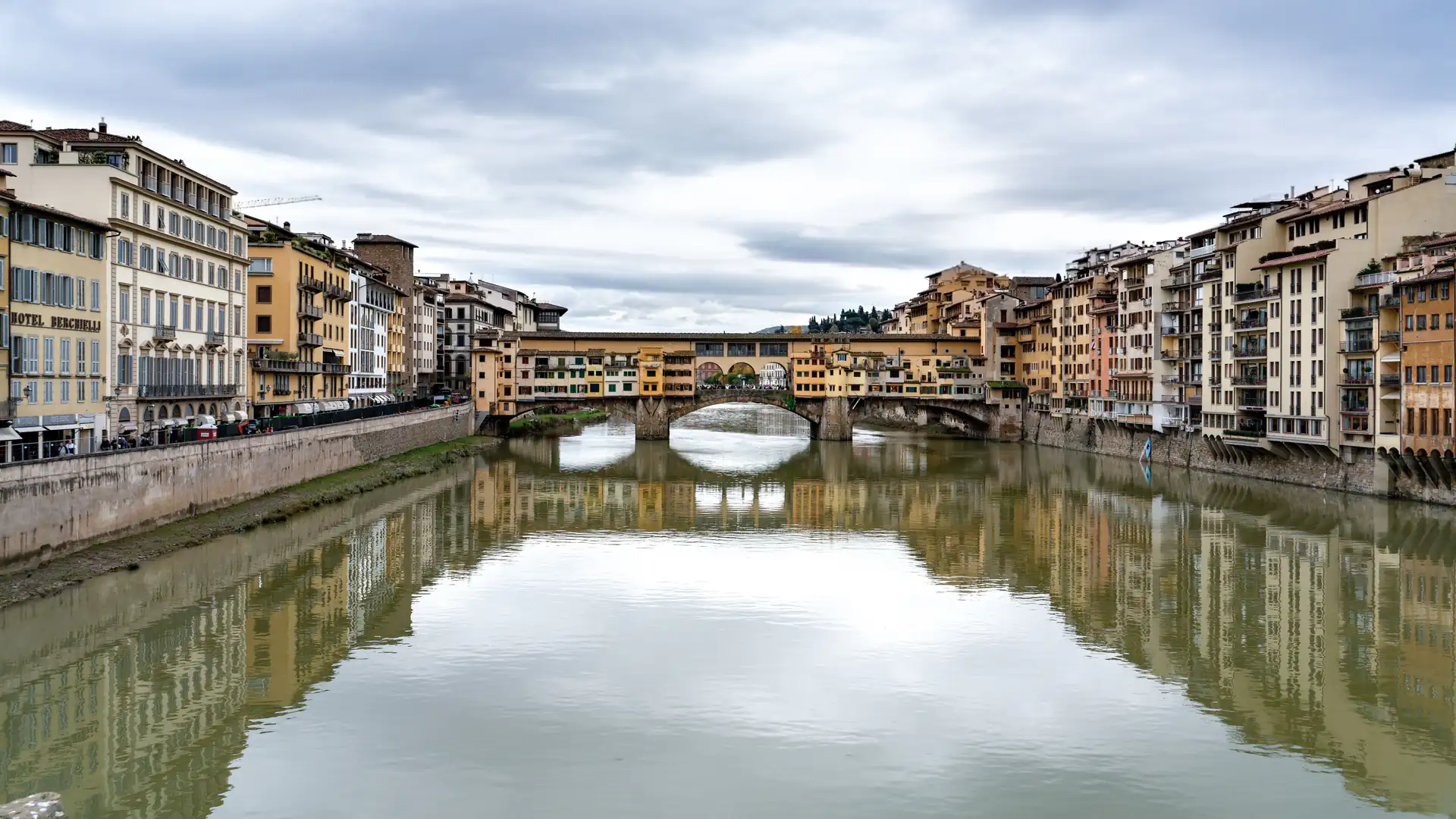
The Vasari Corridor is a covered, elevated passageway in Florence that links the Palazzo Vecchio, the city's seat of government, with the Palazzo Pitti, the Medici residence on the opposite bank of the Arno. It is named for Giorgio Vasari, the Florentine architect, painter and art historian who designed it for Duke Cosimo I de' Medici. Beginning beside the Palazzo Vecchio, the route joins the Uffizi Gallery, follows the north bank of the Arno, crosses the river on top of the Ponte Vecchio, winds around the Torre dei Mannelli, passes above the church of Santa Felicita and finally reaches the Palazzo Pitti in view of the Boboli Gardens. Its full length is approximately one kilometre. Since its December 2024 reopening it is visited on foot as a single one-directional walk, giving an intimate street-level-above-the-street view of Florence found nowhere else in the city.
The Corridor's purpose was practical and political. Duke Cosimo I de' Medici wanted to move freely between his residence and the government palace at a time when, like most monarchs of the period, he felt insecure appearing in public. After the Republic of Florence had been transformed into a Medici hereditary monarchy in 1533, Cosimo governed cautiously amid lingering resentment among Florentine citizens. The enclosed passage let the ruling family cross the city privately, above the heads of the populace, without mixing with the crowded streets and bridges below. Its most notable precedent was the Passetto di Borgo in Rome, the elevated walkway linking the Vatican with the Castel Sant'Angelo, which Vasari knew well from his papal commissions. He adapted that open Roman escape route into an enclosed, private walkway for his Medici patron, a physical expression of the dynasty's grip on Florence.
Who built the Vasari Corridor, and when?
The Vasari Corridor was commissioned in 1564 by Duke Cosimo I de' Medici and designed by Giorgio Vasari, the architect and painter best known for his book Lives of the Most Excellent Painters, Sculptors, and Architects. The works were carried out at extraordinary speed: the passage was intended to be finished in about five months, in time to commemorate the 1565 marriage of Cosimo's son Francesco to Johanna of Austria. Building an enclosed, elevated structure roughly a kilometre long, threading between existing buildings and over a working bridge in a matter of months, was a remarkable feat of Renaissance engineering. Vasari also pierced sections of the passage with decorative windows to give views of the Arno and the city. The goldsmiths' shops that line the Ponte Vecchio today were established there by 1593, after the bridge's earlier meat market was moved so its smell would not reach the private passage above.
Where the Corridor crosses the Ponte Vecchio, a series of panoramic windows faces the Arno toward the Ponte Santa Trinita. After the bridge, the passage was forced to detour around the Torre dei Mannelli, whose owning family refused to allow their tower's demolition; the Corridor was instead attached to the tower's western side on stone brackets, a compromise still visible today. It then passes over the loggia of the church of Santa Felicita, where a balcony protected by a thick railing once let the Grand Duke's family follow Mass from above without mixing with the congregation. From the middle of the 17th century, Cardinal Leopoldo de' Medici turned the Corridor into a gallery of artists' self-portraits, a collection that grew to hundreds of works. That self-portrait collection is no longer displayed inside the Corridor; it was moved into dedicated rooms within the main Uffizi galleries during the restoration.
What is inside the Corridor now?
Since the 2024 reopening, the Vasari Corridor is presented as a walk through the historic structure itself rather than as a picture gallery. The self-portrait collection that once made it famous has been relocated into rooms inside the main Uffizi Galleries, so the reopened passage is defined instead by its architecture, its windows and the story of the building. Along the route the Uffizi has arranged a display of ancient Greek and Roman marble inscriptions from the grand-ducal epigraphic collection, together with a series of Greco-Roman portrait busts placed along the stretch suspended over the city. There are also 16th-century decorative elements associated with Vasari's own work. The great appeal, though, is the experience of walking the enclosed passage: the round and rectangular windows framing the Arno, the Ponte Vecchio and the Florentine rooftops make the Corridor itself the principal exhibit, a rare privately routed line drawn straight through the heart of the city.
The reopened Corridor also incorporates memorial spaces reflecting the harder chapters of its history. The section closest to the Uffizi entrance was heavily damaged by the Via dei Georgofili bombing on the night of 27 May 1993, a Mafia car-bomb attack that killed five people and damaged this part of the gallery; several artworks were destroyed and have since been pieced back together and returned to their positions as a reminder of the event. The Corridor had earlier suffered in the 1943 bombing of Florence during the Second World War and again in the catastrophic 1966 flood of the Arno, which required extensive restoration before an earlier public opening. Walking the route today, you pass through both the Renaissance ambition of the Medici and the twentieth-century wounds the structure survived, which gives the quiet, restored passage a weight beyond its views.
How does the combined Uffizi and Corridor ticket work?
The Vasari Corridor is not sold on its own. Access is by a combined Uffizi Galleries and Vasari Corridor ticket that admits you both to the gallery and to the timed Corridor walk, and reservation is required rather than optional. Since the 2024 reopening, the Corridor can be visited Tuesday to Sunday and is closed on Mondays, in line with the Uffizi. Visits run in small timed groups, and the walk is one-directional: once you have started along the Corridor you cannot turn back into the gallery, so you tour the Uffizi first and the Corridor as the final leg. Daily capacity is deliberately limited to protect the historic structure, which is the main reason slots are scarce. On the days when Uffizi entry is free — generally the first Sunday of each month — Corridor entry is also free, but must still be pre-booked because of the limited places.
Because places are so limited and the booking calendar releases dates on a short horizon, the combined ticket sells out quickly and returned or newly released slots are taken. The most reliable approach is to plan ahead and secure your date as early as you can rather than hoping for walk-up availability, which is not realistic for the Corridor. Bring valid photo identification that matches your booking, since Corridor tickets are checked at entry. Our concierge recommendation is to treat the Corridor as the fixed anchor of your Florence day and build the rest of your itinerary — the Uffizi, the Ponte Vecchio and the Oltrarno — around the timed slot once it is confirmed. Allow enough time before your Corridor entry to enjoy the Uffizi, because you enter the passage from inside the gallery.
How should I plan a visit around the Corridor?
Plan for at least a half-day in the Uffizi-and-Corridor complex, because the combined ticket covers both and the Corridor walk begins inside the gallery. A sensible sequence is to arrive with time to see the Uffizi's main rooms first — its Botticelli, Leonardo and Michelangelo holdings alone reward a couple of hours — and then join your timed Corridor group, since the passage is one-directional and ends on the Pitti Palace side of the river. The walk itself is not long in distance, roughly a kilometre, but it is the once-in-a-visit part of the day, so it is worth arriving unhurried. Spring and autumn are the most comfortable seasons in Florence, with milder temperatures than the high-summer peak. Whatever the season, the Corridor group size is capped year-round, so the experience inside stays intimate regardless of how busy the city outside is.
Because the Corridor exits toward the Palazzo Pitti and the Boboli Gardens in the Oltrarno district, it makes sense to plan the rest of your day on that side of the Arno. After the walk you emerge close to the Pitti Palace, from where the Boboli Gardens, the Palazzo Pitti museums and the quieter Oltrarno streets are all within a short stroll. Coming the other way, the Uffizi sits beside Piazza della Signoria, a few minutes on foot from the Duomo and the Ponte Vecchio, so the whole route ties together Florence's central landmarks in one line. Our concierge recommendation is to book the Corridor slot first, then reserve any separate Boboli or Pitti time for afterwards, keeping the morning for the Uffizi and the Corridor and the afternoon for the Oltrarno. Wear comfortable shoes, as the historic centre is best explored on foot.
Frequently asked
What is the Vasari Corridor?
The Vasari Corridor is an elevated, enclosed passageway in Florence, roughly one kilometre long, that links the Palazzo Vecchio and the Uffizi with the Palazzo Pitti across the Arno, running over the top of the Ponte Vecchio. It was designed by Giorgio Vasari for Duke Cosimo I de' Medici and reopened to the public in December 2024.
When did the Vasari Corridor reopen?
The Corridor reopened to the public in December 2024 after being closed since 2016 for safety reasons and a lengthy restoration. Access is now timed and limited, available Tuesday to Sunday as part of a combined Uffizi and Vasari Corridor ticket.
Who built the Vasari Corridor and when?
It was commissioned in 1564 by Duke Cosimo I de' Medici and designed by the architect and painter Giorgio Vasari. The work was carried out rapidly to commemorate the 1565 marriage of Cosimo's son Francesco to Johanna of Austria.
Can you visit the Vasari Corridor without the Uffizi?
No. Access is by a combined Uffizi Galleries and Vasari Corridor ticket, and the walk begins inside the gallery. There is no Corridor-only option, and the same ticket admits you to both, with reservation required.
Is the Vasari Corridor still a self-portrait gallery?
No longer. The famous collection of artists' self-portraits was moved into dedicated rooms inside the main Uffizi Galleries during the restoration. The reopened Corridor is experienced as a walk through the structure, with marble inscriptions and Greco-Roman busts along the route.
What days is the Vasari Corridor open?
The Corridor can be visited Tuesday to Sunday and is closed on Mondays, in line with the Uffizi Galleries. Visits run in small timed groups, and reservation is required because daily capacity is deliberately limited.
How long is the Vasari Corridor walk?
The Corridor is approximately one kilometre long. The walk is one-directional, running from the Uffizi over the Ponte Vecchio toward the Palazzo Pitti, so you cannot turn back into the gallery once you have started.
Do Vasari Corridor tickets sell out?
Yes. Because daily capacity is deliberately limited and the calendar releases dates on a short horizon, the combined ticket sells out quickly and returned slots are taken within hours. Planning and booking as early as possible is the only reliable approach.
How much time should I allow for the visit?
Allow at least a half-day, as the combined ticket covers both the Uffizi and the Corridor and the walk begins inside the gallery. Plan a couple of hours for the Uffizi's main rooms before your timed Corridor slot.