 Skip-the-line available
 The History of the Vasari Corridor
How Giorgio Vasari built the Medici's private passage over Florence in 1565 — and how it survived war, flood and a bombing to reopen in 2024.
The Vasari Corridor was commissioned in 1564 by Duke Cosimo I de' Medici and designed by Giorgio Vasari, the Florentine architect, painter and author of the Lives of the Artists. Built at speed to be ready for the 1565 marriage of Cosimo's son Francesco to Johanna of Austria, the enclosed, elevated passage let the ruling family move privately between the Palazzo Vecchio, the Uffizi and their residence at the Palazzo Pitti, crossing the Arno on top of the Ponte Vecchio. Over more than four centuries it became a self-portrait gallery, survived wartime bombing, the 1966 flood and a 1993 Mafia bomb, and closed in 2016 before reopening to the public in December 2024. This guide traces that history from Vasari's design to the restored passage visitors walk today.
Why was the Vasari Corridor built?
The Vasari Corridor was built so the Medici could move through Florence in private. Duke Cosimo I de' Medici commissioned it in 1564 because, like most monarchs of the period, he felt insecure appearing among the public. After the Republic of Florence had been transformed into a Medici hereditary monarchy in 1533 — a change that provoked bitter resentment and may have contributed to an earlier duke's assassination — Cosimo governed cautiously in an unstable political climate. An enclosed, elevated passage let him and his family pass between the government seat and their residence without mixing with the crowded streets and bridges below. The idea was not new: its most notable precedent was the Passetto di Borgo in Rome, the raised walkway linking the Vatican with the Castel Sant'Angelo, first commissioned by Pope Nicholas III in 1277 as an escape route in times of danger.
Vasari knew that Roman precedent well. Through his many papal commissions he had extensive first-hand experience of Roman architecture, including the open elevated passetto, and he adapted that concept into an enclosed, private walkway for his Medici patron. The result was both a piece of urban infrastructure and a statement of power: a line drawn straight through the heart of Florence that only the ruling family could use, physically raising the Medici above the citizens they governed. The passage connected the Palazzo Vecchio and the Uffizi on one bank of the Arno with the Palazzo Pitti on the other, so that the seat of government and the ducal residence became a single secure route. In this sense the Corridor expressed the Medici grip on the city as clearly as any painting or palace they commissioned in the same era.
Who was Giorgio Vasari?
Giorgio Vasari was a Florentine painter, architect and writer, and the figure for whom the Corridor is named. He is best known today for his book, the Lives of the Most Excellent Painters, Sculptors, and Architects, which effectively founded the discipline of art history and shaped how the Renaissance has been understood ever since. As an architect in the service of Duke Cosimo I de' Medici, Vasari designed the Uffizi — originally built as government offices — and it was into that new complex that he threaded the elevated Corridor. He was also instrumental in founding the Accademia del Disegno, reflecting a broader Medici and Florentine investment in raising the cultural status of artists, a cause Vasari championed throughout his career. His work as Cosimo's court architect makes the Corridor and the Uffizi two halves of a single vision, and the passage that carries his name is the most literal expression of that role, threading his own gallery building into a private route across Florence.
The Corridor was one of Vasari's most demanding commissions precisely because of the timescale. The passage was intended to be completed in about five months, in time to commemorate the 1565 marriage of Cosimo's son Francesco to Johanna of Austria. To achieve that, Vasari had to route a continuous enclosed structure roughly a kilometre long between existing buildings, along the riverbank and over the working shops of the Ponte Vecchio, without demolishing them. He pierced the passage with decorative windows to light it and to give views of the Arno and the city, and at the Ponte Vecchio arranged a run of panoramic windows facing toward the Ponte Santa Trinita. The speed and ingenuity of the build made it one of the signal engineering achievements of mid-16th-century Florence. Completed in time for the wedding festivities, the passage stood as a monument to both Medici power and Vasari's ingenuity, and its rapid construction in the mid-1560s remains one of the most quoted facts about it.
What happened at the Ponte Vecchio and the Mannelli Tower?
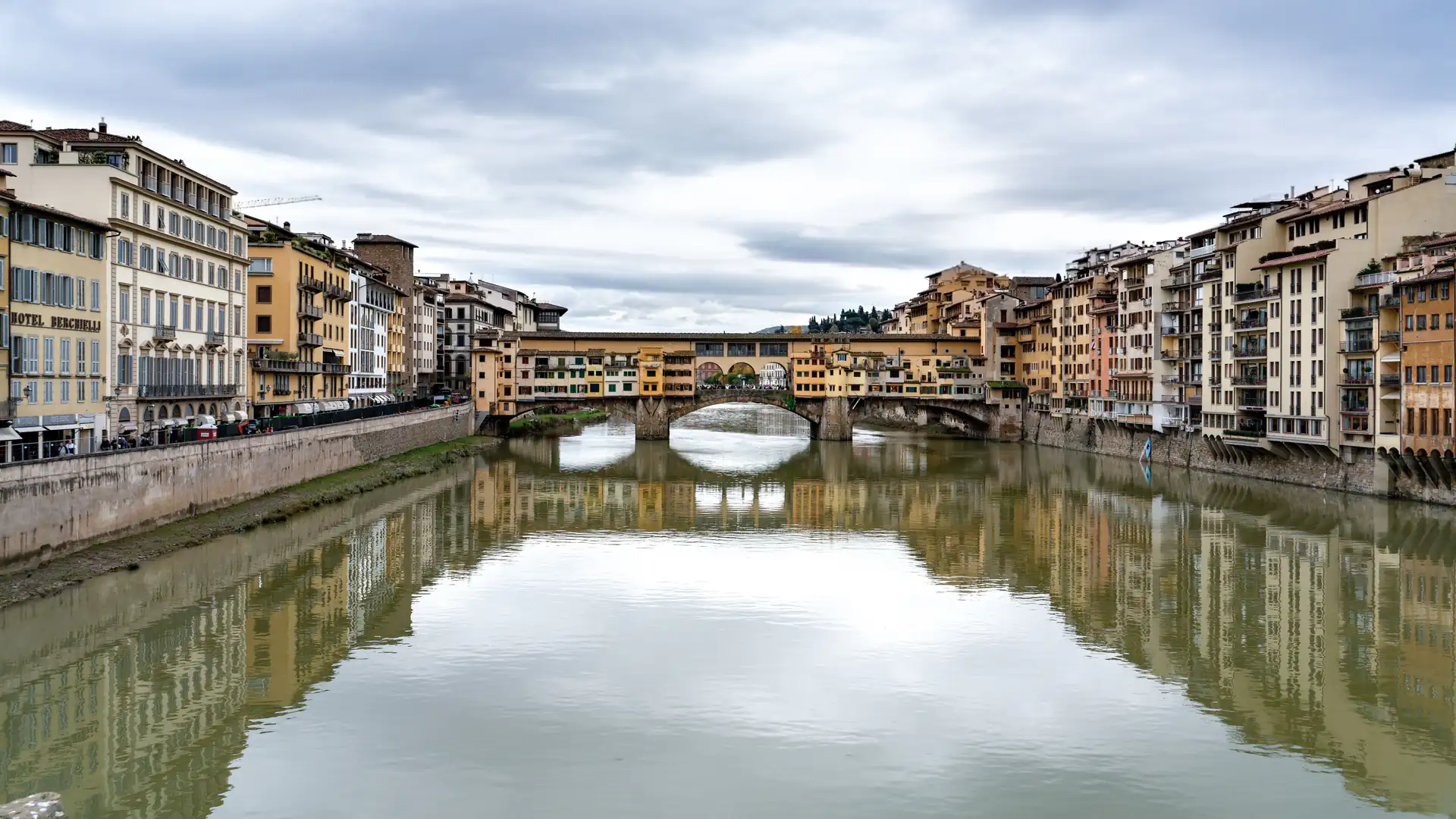
Carrying the Corridor across the Ponte Vecchio required routing it above the bridge's shops rather than removing them. At the time the bridge housed a meat market, and the market was moved so its smell would not reach into the private passage overhead; its place was taken by goldsmiths' shops, which were established on the bridge by 1593 and still occupy it today. In the middle of the Ponte Vecchio the Corridor is marked by a series of panoramic windows facing the Arno toward the Ponte Santa Trinita, one of the most recognisable features of the whole route. This detour over the shops is the reason the passage appears to ride along the top of the bridge, a silhouette that has become one of the defining images of Florence. That silhouette, the enclosed passage riding along the crown of the bridge above the goldsmiths, is exactly what visitors photograph from the riverbanks today, more than four centuries after it was built in 1565.
After the Ponte Vecchio the Corridor met an obstacle it could not simply push through. The Torre dei Mannelli stood in its path, but the family who owned the tower staunchly opposed its demolition, so the passage was forced to bend around it and was attached to the tower's western side on stone brackets — a visible compromise that survives today. Beyond the tower the Corridor passes over the loggia of the church of Santa Felicita, where it was given a balcony protected by a thick railing looking down into the church interior. From that private balcony the Grand Duke's family could follow Mass without mixing with the ordinary congregation below, another instance of the passage keeping the Medici physically apart from the population of Florence. These two obstacles, the Mannelli Tower and the church of Santa Felicita, show how the Corridor was fitted around the existing city rather than clearing a path through it, and both detours survive along the route walked today.
What was the self-portrait collection?
In the middle of the seventeenth century, Cardinal Leopoldo de' Medici transformed the Corridor into a gallery of famous artists' self-portraits. Over the following centuries the collection grew to hundreds of paintings, including works associated with figures such as Leonardo da Vinci, Andrea del Sarto, Michelangelo, Sofonisba Anguissola, Domenico Beccafumi and Gian Lorenzo Bernini. The idea of gathering artists' self-portraits reflected a broader Medici investment in the cultural status of the artist — the same conviction Vasari had championed in his Lives of the Artists and through his founding role in the Accademia del Disegno. For generations, that self-portrait gallery was the headline reason visitors sought out the Corridor. The collection eventually numbered hundreds of paintings and became internationally famous, drawing visitors specifically to walk the passage and see artists depicting themselves. For generations this made the Vasari Corridor unique among the world's galleries, a corridor of faces lining the private Medici route across the Arno.
The self-portrait collection is no longer displayed inside the Corridor. During the recent restoration ahead of the 2024 reopening, the self-portraits were moved into dedicated rooms within the main Uffizi Galleries, where they can be shown under better conservation conditions and seen by more visitors. The reopened Corridor is therefore experienced differently from the version that operated in earlier decades: instead of a picture gallery, it is presented as a walk through the historic structure, lined now with ancient marble inscriptions and Greco-Roman portrait busts. Visitors who remember the old self-portrait route should know that the paintings are still in the Uffizi — simply relocated into the galleries rather than hung along the passage itself. This means today's visitors experience a different Corridor from the one older guidebooks describe: the paintings survive and can still be seen, but they are now shown within the Uffizi galleries rather than along the passage, and the Corridor stands as an architectural and historical monument in its own right since December 2024.
How did the Corridor survive war, flood and a bombing?
The Vasari Corridor has been damaged repeatedly since its construction, and its survival is part of its story. During the Second World War it was damaged in the 1943 bombing of Florence, and it was then further affected by the catastrophic 1966 flood of the Arno, which swept through the low-lying centre and required extensive restoration of the passage and the surrounding buildings. In 1974 the restored Corridor officially opened to the public, allowing visitors to view the self-portrait collection and other paintings for the first time. Each of these episodes left its mark on the structure and shaped the restoration choices that would follow in later decades. That 1974 opening was the first time the general public could walk the Medici's private passage and view the self-portrait collection along it, ending centuries in which the Corridor had been reserved to the ruling family and, later, to privileged visitors. It marked a turning point in the passage's long history from private route to public monument.
The gravest recent wound came on the night of 27 May 1993, when the Via dei Georgofili bombing — a Mafia car-bomb attack near the Torre dei Pulci beside the Uffizi — killed five people and damaged the section of the gallery closest to the Corridor entrance. Several artworks were badly damaged; some have been pieced back together and returned to their positions to serve as a reminder of the attack. After a renovation the Uffizi and the Corridor reopened in 1998 with additional works on display. The Corridor was then closed again in 2016 for safety reasons and remained shut until its reopening to the public in December 2024, following a further lengthy restoration that rebuilt the passage for modern visiting. Taken together, the 1943 bombing, the 1966 flood, the 1993 attack and the 2016 safety closure form a chain of disruptions that repeatedly interrupted access to the Corridor before its full restoration and reopening to the public in December 2024.
Frequently asked
When was the Vasari Corridor built?
It was commissioned in 1564 by Duke Cosimo I de' Medici and built rapidly to be ready for the 1565 marriage of his son Francesco to Johanna of Austria. The passage was intended to be completed in about five months.
Who designed the Vasari Corridor?
It was designed by Giorgio Vasari, the Florentine architect, painter and author of the Lives of the Artists, who also designed the Uffizi. The Corridor is named after him and threads through the Uffizi complex he built.
Why was the Vasari Corridor built?
So the Medici could move privately between the Palazzo Vecchio, the Uffizi and their residence at the Palazzo Pitti without mixing with the public. Cosimo I felt insecure appearing among the crowds after Florence became a hereditary Medici monarchy in 1533.
Why are there goldsmiths on the Ponte Vecchio?
When the Corridor was routed over the bridge, the earlier meat market was moved so its smell would not reach the private passage above. Goldsmiths' shops took its place and were established there by 1593; they still occupy the bridge today.
What is the Torre dei Mannelli?
The Torre dei Mannelli is a medieval tower that stood in the Corridor's path after the Ponte Vecchio. Its owning family refused to allow demolition, so the passage was bent around it and attached to the tower's western side on stone brackets, a detour still visible today.
Was the Vasari Corridor once a self-portrait gallery?
Yes. From the mid-17th century, Cardinal Leopoldo de' Medici turned it into a gallery of artists' self-portraits that grew to hundreds of works. That collection has since been moved into dedicated rooms inside the main Uffizi Galleries.
How was the Corridor damaged in the 20th century?
It was damaged in the 1943 bombing of Florence and again by the 1966 flood of the Arno. In 1993 the Via dei Georgofili Mafia bombing near the Uffizi killed five people and damaged the section nearest the Corridor entrance.
When did the Vasari Corridor reopen?
After closing in 2016 for safety reasons, it reopened to the public in December 2024 following a lengthy restoration. Access is now timed and limited, available Tuesday to Sunday as part of a combined Uffizi and Vasari Corridor ticket.
How long is the Vasari Corridor?
The Corridor's full length is approximately one kilometre. It runs from the Palazzo Vecchio and the Uffizi, over the top of the Ponte Vecchio, around the Torre dei Mannelli and above Santa Felicita, to the Palazzo Pitti.